

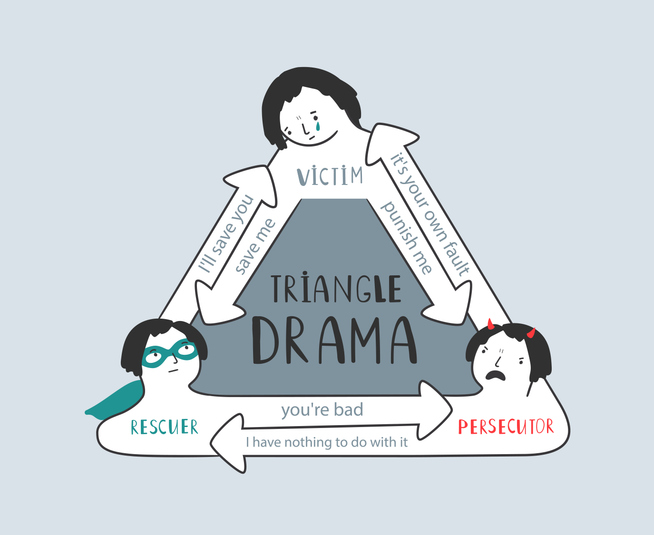
At least once in our lifetimes, we have been involved in or enmeshed in unhealthy and manipulative relationships where we have, knowingly or unknowingly, played psychological games. Developed by Stephen Karpman in 1968, the Karpman Drama Triangle helps us understand this dynamic. It studies human interaction to explain and understand destructive interpersonal relationship patterns, based on the interplay of three psychological characters: Persecutor (villain), Rescuer (hero), and Victim (damsel in distress). These intrinsically and simultaneously connected roles are found in most, if not all, individuals involved in family dysfunctions. In such relationships all three roles are enacted by self and other parties at the same time, without an awareness of or control over their damaging consequences.
The framework theorizes that people create personal stories to make sense of their interpersonal relationships and the world and that these fairy tales inadvertently reinforce social roles. These mental representations serve the purpose of guiding perceptions of the self in connection to others and consciously and unconsciously influence interpersonal decisions throughout life. The drama triangle also explains how people become stuck in the cycle of wanting their needs met without explicitly stating what they want and need from others, and how people could become trapped in the pattern of cycling through the roles of the Victim, Persecutor, and Rescue in interpersonal conflicts. As part of the drama, individuals can unintentionally switch from one position to another and thereby compromise the possibility of developing and maintaining healthy relationships.
Persecutors
Persecutors are the ones that are hypercritical and aggressive, often blaming others for their adversities. They often think of themselves as superior and entitled, thereby demeaning and attacking others when the opportunity arises. Persecutors deem themselves to be always correct and are prone to pointing the finger at others in episodes of interpersonal conflict. As a rseylt, they stay stuck in toxic behavioral patterns by antagonizing and oppressing those perceived to be the source of their frustrations. Persecutors tend to experience and express feelings of anger, irritation, and rage toward others.
Imagine a parent telling their child, “You never do anything properly. I can’t trust you with even the smallest responsibility.” The parent may believe they are correcting the child’s behaviour, but the constant criticism can leave the child feeling inadequate and afraid of making mistakes.
Rescuers
Rescuers possess the innate and elevated need or desire to help other people. They possess the mindset that they are peacemakers, saints, or martyrs, and consequently go out of their way to help people they believe to be too psychologically, emotionally, or physically weak to fend for themselves. Their social lives often tend to be in disarray as they spend a large amount of time in improving, changing or controlling the behaviors of others. Rescuers believe that they know what is best for others by offering unsolicited advice and help. Their emotional states are portrayed by feelings of euphoria, self-importance, and excitement especially during acts of helping others. For example, when a young adult struggles to manage their finances, a parent may repeatedly pay their bills, make their decisions, and shield them from the consequences of their choices. Although this may come from love, it can unintentionally prevent the young adult from developing confidence and independence.Victims
Victims often communicate helplessness and oppression, always perceiving that undesirable and uncontrollable events keep happening to them and will continue to happen in the future. Although people assuming this role may or may not be actual victims, these individuals believe that they are unable to make decisions, have difficulties solving their problems, and perceive powerlessness against others. They are characterized by emotional dysregulation and painful emotional experiences, including anxiety, depressed states, fear, hopelessness, and sadness.
Consider someone who repeatedly turns to a family member to resolve their difficulties but gradually loses confidence in their own ability to cope. Over time, they may begin to believe that they cannot manage without help, even when they have the capacity to learn and make their own decisions.
In the dynamic of the drama triangle, every conflict scenario requires a person adopting the Victim role, because Victims receive blame from the Persecutor and help from the Rescuer.
How the Drama Triangle Plays Out in Families
The difficult part about the Karpman Drama Triangle is that nobody necessarily stays in one role. Imagine a family where a teenager receives poor grades. One parent becomes the Persecutor, criticising the teenager for being irresponsible. The other parent steps in as the Rescuer, defending the teenager and promising to handle the situation. The teenager, meanwhile, feels helpless and assumes that their parents will sort everything out. At first, each person may believe they are doing the right thing. One parent wants to encourage responsibility, the other wants to protect their child, and the teenager wants relief from the pressure.
But the situation can quickly change. The first parent becomes frustrated with the other for constantly interfering. The Rescuer begins to feel caught in the middle and complains that nobody appreciates their efforts. The teenager, tired of being criticised, may lash out and accuse both parents of being unfair. Suddenly, the Persecutor feels attacked and becomes the Victim. The Rescuer may turn into the Persecutor, criticising everyone for being ungrateful. The original victim may now use anger or blame to defend themselves.
While the roles have changed, the underlying problem remains unresolved. This is how the Drama Triangle can keep families stuck in repetitive arguments. Attention shifts from the actual issue to who is at fault, who needs saving, and who has been hurt the most. Over time, these patterns can affect trust, communication, and emotional wellbeing. Family members may become more guarded, children may learn to avoid responsibility or conflict, and adults may carry familiar relationship patterns into their friendships, romantic relationships, and future families.
Breaking Free from the Cycle
Stepping out of the Drama Triangle does not mean becoming emotionally detached, refusing to help others, or never getting angry. It means learning to respond to conflict with greater awareness, personal responsibility, and respect for one another’s boundaries.Helplessness to Problem Solving
Instead of assuming that nothing can change, begin by identifying what is within your control. You may not be able to change another person’s behaviour, but you can decide how to communicate your concerns, what boundaries to set, and what steps to take next. For example, instead of saying, “Nobody in this family listens to me,” try expressing the specific need underneath the frustration: “I feel unheard when I’m interrupted. Can we take turns speaking?” Small changes in communication can create room for more meaningful conversations.
Supportive Coaching rather than Rescuing
Supporting someone does not mean solving every problem for them. Sometimes, the most helpful thing you can do is listen without immediately offering advice, ask questions, and allow the person to decide what they want to do. Instead of saying, “Give it to me. I’ll handle it,” try asking, “What do you think would help you manage this? Would you like me to help you think through your options?” This allows you to remain caring and involved without taking away the other person’s opportunity to learn, make decisions, and build confidence.
Replace Blame with Assertive Communication
When we feel angry or disappointed, it can be tempting to criticise, lecture, or bring up past mistakes. However, blaming someone often makes them defensive rather than more willing to listen. Try focusing on the behaviour, its impact, and what needs to change. For instance, instead of saying, “You’re so irresponsible. I can never depend on you,” you could say, “When the task isn’t completed by the agreed time, it affects the rest of the family. Can we decide how to manage this going forward?” Being assertive does not mean being aggressive. It means expressing your needs clearly while respecting that the other person has their own perspective.
Pause Before Reacting
Family conflicts can bring up strong emotions, especially when they touch on old hurts or familiar patterns. When emotions run high, we may respond automatically rather than thoughtfully. A brief pause can help. Take a few slow breaths, notice what you are feeling, and ask yourself: “Am I trying to solve the problem, or am I trying to prove that I’m right?” If you need more time, it is okay to say, “I’m feeling overwhelmed right now. I want us to discuss this properly, but I need a little time before we continue.” This is particularly helpful when emotional dysregulation makes it difficult to manage anger, anxiety, or distress during disagreements.Practise Boundaries and Direct Communication
Unspoken expectations often create resentment. A person may expect their family to understand what they need without being told, while another may assume that helping is always welcome. Instead of expecting others to guess, communicate directly. Ask for help when you need it, clarify what you can realistically offer, and learn to say no without feeling that you must justify every decision.Take Responsibility without Taking all the Blame
Taking responsibility means acknowledging your feelings, actions, and contribution to a situation. It does not mean accepting fault for everything that goes wrong, nor does it mean tolerating someone else’s hurtful behaviour. You might ask yourself, “What could I have done differently?” or “Is there something I need to communicate more clearly next time?” These questions shift the focus from winning the argument to understanding what can change.
The Karpman Drama Triangle helps us recognise how families can become caught in repetitive patterns of blame, rescuing, and helplessness, often without realising how these roles affect one another. Over time, these dynamics can reinforce emotional dysregulation, weaken boundaries, and shape how family members approach relationships beyond the home. Breaking the cycle does not mean deciding who the villain is; it means recognising the pattern, taking responsibility for our own responses, and learning to communicate, support, and resolve conflict differently. When families replace blame with accountability, rescuing with empowerment, and helplessness with problem-solving, they create space for healthier relationships. The cycle may have begun before us, but with awareness and intentional change, it does not have to continue through us.
Photo Credits: S-S-S
Citations
Division of HR, Office of Organizational and Professional Development. (n.d.). ESCAPING THE DRAMA TRIANGLE. https://sc.edu/about/offices_and_divisions/human_resources/docs/escaping_the_drama_triangle.pdf
L’Abate, L. (2009). The drama triangle: An attempt to resurrect a neglected pathogenic model in family therapy theory and practice. The American Journal of Family Therapy, 37(1), 1-11.
Lac, A., & Donaldson, C. D. (2022). Development and validation of the drama triangle scale: Are you a victim, rescuer, or persecutor?. Journal of interpersonal violence, 37(7-8), NP4057-NP4081.

Sakshi
About the author
Sakshi is a clinical psychologist with a deep passion for understanding human behavior, a strong drive for research, and a keen eye for psychological intricacies. Committed to continuous learning, she seeks to explore every facet of psychology, from theory to practice, to better support and empower individuals. With a curiosity that fuels her pursuit of knowledge, she strives to bridge the gap between research and real-world applications, making psychology more accessible and impactful.
Recently Added

Depression affects over 330 million people worldwide and is characterised by low or irregular mood, sleep disturbance and loss of interest or …

At least once in our lifetimes, we have been involved in or enmeshed in unhealthy and manipulative relationships where we have, knowingly …
Praise is one of the most natural parts of human interaction. So stopping it altogether is indeed difficult. However, the better part …