

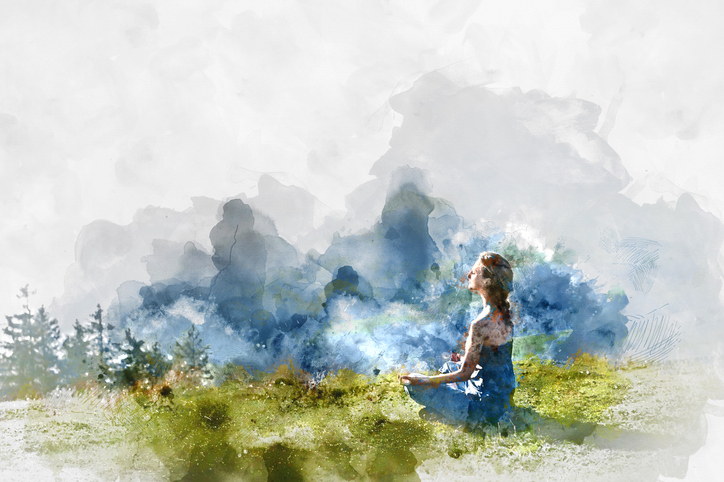
The ideal conditions for creativity are often mental and emotional – involving relaxed, yet alert and focused, states of mind. By contrast, states of anxiety, emotional upheaval, or negative stress can narrow one’s imagination and openness, inhibiting creativity. While meditation does help in regulating stress and improving cognitive, emotional and interpersonal functioning, it also relates to creativity. Meditation and art are both connected to emotions, attention, stress and awareness of the self and world. On one hand, meditation helps in diminishing fear of judgment and enhancing open-minded thinking, and reducing self-conscious thoughts. On the other, it relates directly to creative thinking habits such as relaxation or flow states (improved concentration), risk-taking (requiring a lack of fear about judgment), and curiosity or open-mindedness/openness to experience (reducing self-conscious experience).
Apart from these, meditation aids art in the following ways:
- Increase in empathy
- Positive impact on a person’s creativity in the moment and over time
- Increase in the person’s capacity to respond to situations in a non-habitual manner
- Finding novel solutions to problems
- Increase in an individual’s level of attention and awareness in daily activities, thereby improving creative outcomes
- Changes in thinking skills that improve creativity
- Improvement in divergent thinking
- Enhancement of working memory
- Better verbal fluency in creativity
Connection between Meditation and Creativity
Meditation is an ancient practice that involves training the mind to empty itself of everyday thoughts and concentrate on something very simple such as breathing or simply nothing at all. It supports creativity and creative processes in several ways that we are going to discuss below.
Dealing with Anxiety and Stress
Meditation helps deal with stress, anxiety and other feelings – supporting their creativity. It helps remove mental blocks or habits that become a hindrance to creative pursuits. As meditation helps reduce anxiety, improve focus and build awareness of the mind, clarity of thought, space for new ideas and fresh perspectives, and the ability to work productively increases. Even research has shown that by developing awareness about one’s mind and the present moment, people experience less anxiety, more positive emotions and engagement, and other mental and emotional benefits. When people become more aware of their thinking, they may also become more adept at navigating thought processes in psychologically healthy ways. Meditation may also support creativity by promoting well-being, and freeing people to be creative by releasing emotional blocks. While creative activities by nature have a healing quality, many individuals are still plagued by self-doubt and anxieties. This makes it challenging to engage or focus on their craft. Therefore, meditation can provide a potential mental-emotional health benefit, supporting the creative advantage.
For example, an artist who feels anxious about creating something perfect may practise mindful breathing before painting. This can help them settle their thoughts and focus more on exploring colours and ideas than on judging the final result.
Clarity of Mind
Meditation does not only help before engaging in creative work, but in sustained ways through time. It offers a useful method to bring a greater sense of clarity, calm, and focus to creativity. It also supports the ability to engage in the work of creativity. Additionally, creativity involves more than just coming up with novel ideas. It also requires focusing the mind on actualizing that creativity. Therefore, meditative practices, which support concentration and focus, may be beneficial for moving past distractions or creative blocks, to open the mind and engage in the actual work and focused craft of creativity.
For example, after a short meditation, someone struggling to organise several creative ideas may find it easier to focus on one and work on it without getting distracted.
Managing the “Voice of Judgement”
Meditation also allows one to recognize their self-talk or their voice of judgement. Most people have thousands of thoughts on a daily basis, many of which are counterproductive. This negative internal narrative can greatly diminish creativity. Therefore, by becoming aware of our own thinking, we take some measure of control over it. By noticing your voice of judgement and personifying it (i.e. creating a visual of it), one can become better at managing their self-talk. By personifying thoughts as something external, it is possible to let go of self-narrative or unhelpful thoughts and free up creative thinking.
For example, while sketching, Riya may think, “This looks terrible.” By recognising this as a judgmental thought rather than a fact, she can continue drawing without letting self-criticism stop her.
Facilitating Self-Reflection
Self-reflection is one of the most daunting processes that humans refuse to undertake willingly because of its mental and emotional toll. And whenever we engage in self-reflection, it is usually biased. Through a regular practice of meditation, one can practice acceptance – an acceptance of the past, the future and the present without judgment. Meditation allows us to see how our own actions have brought us to our current pain or happiness. This process is also evident in the creation of art, where reflexivity and acceptance are cultivated from moment to moment. Like meditation, art creates distance between ourselves and our negative thinking. Therefore, creating art is about reaching a state of understanding that breaks us free from the constant debilitating chatter of the mind and cultivating a sense of emotional flexibility. This means that while our emotions are felt readily, we would not be overwhelmed or react uncontrollably.
For example, someone may use colours and shapes to express feelings they find difficult to put into words. Reflecting on the artwork afterwards may help them recognise emotions they had not fully acknowledged.
Enhancing Flow
When you are so focused and intent on completing the work you’ve put your mind to that time flies by, it is said that you are in a ‘flow state.’ when in such a state, it is natural for you to become absorbed in the task at hand. Flow state allows us to perform mental time-travel and alters how we might recall certain memories differently. We become conscious of how quickly or slowly we experience these memories and the emotions that arise from them. Meditation and creating or appreciating art encourage this flow state and cultivates a sense of wholeness within ourselves.
For example, while painting, someone may become so absorbed in mixing colours and exploring patterns that they lose track of time, remaining focused on the creative process rather than everyday worries.
Stable Practices for Your Mind
Art and meditation are both practices that you can consistently fall back on because they are both considered learned skills. Throughout life’s ups and downs, meditation can help you focus on the present and opt for a solution-focused approach rather than avoidance. Similarly, appreciating or creating art can become a skill that offers a safe space to explore your emotions and the inner workings of your mind. Instead of always having to waver between extreme highs and lows, we can opt to practice both meditation and art as they help to nurture a mental space that provides stability and a constant connection to our true selves. Fluctuations are less extreme and there is an increased stability in the mind, which in turn leads to harmony with our physical surroundings and overall wellbeing.
For example, someone going through a stressful week may spend five minutes meditating and then sketch freely for ten minutes each evening. Over time, this routine may offer a regular opportunity to pause, process emotions and reconnect with themselves.
Art and meditation may seem like different practices, but both invite us to slow down, become aware of our inner experiences, and approach them with greater openness. While meditation can help quiet self-criticism and make room for new perspectives, art offers a way to express and explore thoughts and emotions that may be difficult to put into words. Practised together, they can support self-reflection, emotional awareness, and a more flexible approach to everyday challenges. The goal is not to create something perfect or empty the mind of every thought, but to become more present with what is already there. Sometimes, all it takes is a quiet moment, a few deep breaths, and a blank sheet of paper to reconnect with ourselves and discover something new.
Photo Credits: amoklv
Citations
Chan, R. (2021). Meditation and Art Therapy Wellness Benefits. Singapore Art Museum. https://www.singaporeartmuseum.sg/About/Blog/Meditation-and-Art-Therapy-Wellness-Benefits
Henriksen, D., Heywood, W., & Gruber, N. (2022). MEDITATE TO CREATE: MINDFULNESS AND CREATIVITY IN AN ARTS AND DESIGN LEARNING CONTEXT. Creativity Studies, 15(1), 147–168.

Sakshi
About the author
Sakshi is a clinical psychologist with a deep passion for understanding human behavior, a strong drive for research, and a keen eye for psychological intricacies. Committed to continuous learning, she seeks to explore every facet of psychology, from theory to practice, to better support and empower individuals. With a curiosity that fuels her pursuit of knowledge, she strives to bridge the gap between research and real-world applications, making psychology more accessible and impactful.
Recently Added
The ideal conditions for creativity are often mental and emotional – involving relaxed, yet alert and focused, states of mind. By contrast, …
Spirituality empowers human existence with meaning. It helps establish goals and value systems that drive almost all aspects of a person’s life. …

In a world shaped by trends and social influence, following the crowd has become almost second nature. We want a better balance …