

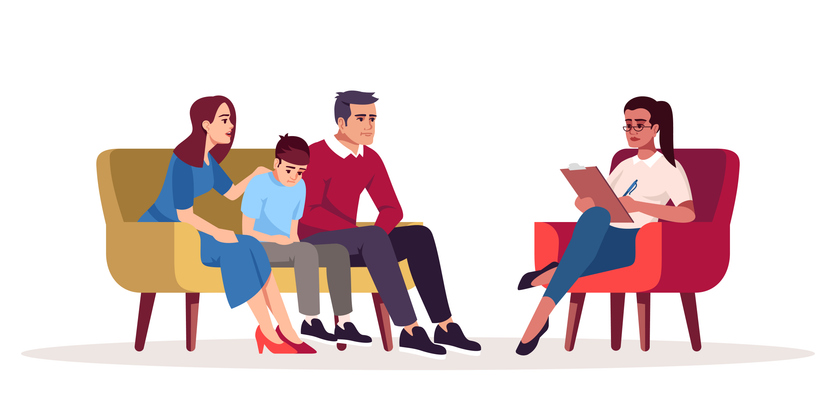
Seeking therapeutic support isn’t the easiest task for any of us. And when families seem to be involved in the mix, it becomes even tougher. Most of us and our families begin to wonder how family counseling would work even before they’ve decided to take it up. While arguments, misunderstandings and periods of strain are common between families and may resolve on their own, sometimes they just don’t. This leads to unresolved conflicts and tension and disconnection within the household, beginning to affect everyone who stays together.
This is where family therapy comes into the picture. With its emergence in the mid-20th century, family counselling has become a long-standing, pivotal intervention that promotes wellbeing of the individuals within the family unit. It materialized as a result of changing family dynamics and is based on the core premise of providing a safe and supportive environment where family members can openly discuss their issues, understand each other’s perspectives, and work together towards resolving conflicts. The counselling process involves various therapeutic approaches that cater to the specific needs of the family, fostering better communication, understanding, and moral guidance. It not only facilitates better parent-child relationships but also promotes the development of social skills, empathy, and ethical decision-making in children.
Problems family counselling can help with
Family counselling is not limited to a particular family structure. It can involve parents and children, siblings, step-families, blended families, or extended family members including grandparents, aunts and uncles — essentially anyone whose relationships are central to the difficulties being addressed. There is no threshold of severity that needs to be crossed before family therapy becomes appropriate.
- Communication Gaps: Repetitive arguments that never get resolved, erosion of trust between family members, consistent feelings of being unheard – all these are the most common communication problems in a family unit. In fact, marital problems can also ripple outward and create tension across the wider family unit. Family counselling helps identify these patterns of behaviours and their underlying cause and thereby, supports families in changing them.
For instance, Daniel’s parents often became frustrated because he spent most of his time in his room and rarely spoke to them. They responded by repeatedly questioning him about school, while Daniel felt pressured and withdrew even further. - Life Changes and Transitions: Divorce and separation, grief following bereavement, blending two families together after a new relationship, or children leaving or returning home can all disrupt the balance within a family and create tension that is difficult to manage alone. Grief in particular can affect individual family members very differently, leading to misunderstandings and disconnection at a time when closeness is most needed. Family counselling provides a space to process those changes together and to adjust to a new way of functioning as a unit.
For example, Sophie’s parents separated after many years of marriage, and each family member responded differently to the change. Sophie became quiet and withdrawn, her younger brother became more irritable, while one parent tried to keep conversations about the separation to a minimum. - Trauma, Addiction and Emotional Strain: When one family member is living with a mental health condition, it can affect the entire family and change how individuals relate to each other. This can create cycles of conflict, mistrust, and exhaustion that are difficult to break without professional support.
For instance, James had been struggling with alcohol misuse, which had gradually affected trust and communication within his family. His parents became increasingly worried and controlling, while James felt judged and became more secretive.
Types of Family Therapy
Family counselling does not work on a fixed method. While the goal of each therapy is to improve the communication between and functioning within the family, the type of therapy depends on the family’s specific needs and the practitioner’s training. Here are some of the most common and effective evidence-based options used today.
Systemic Family Therapy
Systemic family therapy is one of the leading forms of family therapies that looks at families as a system. Systemic family therapists work on the premise that if one part of the system changes, the whole system will run differently. Instead of asking “Who is to blame?” they look at the patterns of communication. This allows families to create a more supportive environment where everyone feels secure.
For example, Olivia frequently argued with her teenage daughter about schoolwork. Her parents responded by increasing restrictions, which led Olivia to become more secretive and resistant. A systemic family therapist might explore this cycle rather than identifying Olivia as “the problem.” Changing how the parents respond could, in turn, change how Olivia responds, gradually shifting the dynamics within the entire family.
Cognitive Behavioural Therapy for Families
Cognitive behavioral therapy has been the go-to choice for individuals but it also works very well with couples and families. Being practical and grounded in the present, this form of therapy helps in identifying negative thought patterns that may lead to arguments of disagreements between members of a family. By working on these thoughts, it helps in improving day-to-day living and problem-solving.
For instance, Michael believed that his parents “never trusted him,” while his parents believed that he “never listened.” These assumptions often triggered arguments before either person had a chance to explain themselves. Family-focused CBT could help them identify these automatic thoughts, examine whether they were accurate, and practise more balanced ways of interpreting each other’s behaviour.
Narrative Family Therapy
Narrative therapy is a powerful approach based on the idea that we all tell stories about our lives. Sometimes, a family gets stuck in a negative story. In a family therapy session, the narrative therapist helps families “re-write” this story, focusing on shared strengths and hopes for the future.
For example, Charlotte’s family had begun to describe themselves as “a family that is always fighting.” During narrative family therapy, the therapist might help them identify moments when they had supported one another despite their conflicts. Gradually, the family could develop a more balanced story—one that recognises their difficulties while also highlighting their strengths, care, and ability to overcome challenges together.
Strategic Family Therapy
In strategic family therapy, the therapist takes a more active role. They look at how the family functions and design specific tasks to change how members interact. These family therapy techniques are often used to address specific behavioural problems, including challenging behaviours in children or teens, helping to shift the power balance in a healthy way.
For instance, Ben’s parents frequently argued about how to respond to his challenging behaviour at home. One parent would become very strict while the other would immediately give in, leaving Ben unsure about boundaries and the parents frustrated with each other. A strategic family therapist might introduce specific tasks designed to change this interaction pattern and establish more consistent responses.
How does Family Counselling work?
Uncertainty is the biggest barrier to individuals seeking support. Therefore, understanding the process of family counseling can provide answers to a few questions and make it much easier to take the first step.The Initial Assessment
A typical family therapy session lasts about 50 to 60 minutes where the therapist creates a structured and relaxed environment. Everyone is encouraged to speak and no one is put on the spot or required to say more than they are comfortable with. It is usually low-pressure talk. The conversation is guided (rather than controlled) by the therapist as this is the chance where the family therapist is trying to understand everyone’s perspective. Their role is to help individual family members hear one another more clearly, to notice patterns in how the family communicates, and to introduce new ways of thinking about longstanding difficulties. The focus is on understanding the dynamics at play rather than on establishing who is right and who is wrong. Towards the end, you will discuss what you hope to achieve and how the sessions will work. Moreover, not everyone has to be in the room for every single session. Your therapist might meet with different members at different times before bringing everyone back together.
For example, Daniel’s parents had become increasingly frustrated because he spent most of his time in his room and rarely spoke to them. They responded by repeatedly questioning him about school, friends, and his daily activities, which made Daniel feel pressured and caused him to withdraw even further. During a family counselling session, the therapist might help each family member describe how they experience this pattern without interrupting or blaming one another.
The therapist could then help the family recognise the cycle: the parents’ worry leads to repeated questioning, Daniel feels overwhelmed and withdraws, and his withdrawal increases their worry. Together, they may explore alternative ways of communicating, such as giving Daniel space while creating a regular time for a calm conversation. Over several sessions, the family can practise these new ways of interacting and gradually develop a more open and supportive relationship.
Family counselling provides a safe space for family members to understand one another, address unresolved conflicts, and develop healthier ways of communicating. Rather than focusing on who is right or wrong, family therapy looks at the patterns and dynamics that may be contributing to difficulties. With the guidance of a trained therapist, families can learn to communicate more openly, manage disagreements, rebuild trust, and support one another more effectively. While change may take time, even small shifts in how family members respond to each other can create meaningful improvements in the overall family relationship.
Photo Credits: bsd555
Citations
HUSSAINI, Y., Adamu, I., JIBRIL, Z., & ABDUL, I. (2025). ROLES OF FAMILY COUNSELLING IN ENHANCING MORAL DEVELOPMENT AND WELLBEING IN DIVERSE FAMILY STRUCTURES. Journal of Professional Counselling, 8(1), 43-54.
Select Psychology Team. (2026). How does family counselling work? A practical guide for families. Select Psychology. https://selectpsychology.co.uk/blog/family/how-does-family-counselling-work/
Select Psychology Team. (2026). Understanding the different types of family therapy: A guide for UK families. Select Psychology. https://selectpsychology.co.uk/blog/family/types-of-family-therapy/?_gl=1*nivgia*_up*MQ..*_ga*NDAwNTkyNzQ2LjE3ODYxODA4MDU.*_ga_5R9HNZHQRW*czE3ODYxODA4MDQkbzEkZzAkdDE3ODYxODA4MDQkajYwJGwwJGgw

Sakshi
About the author
Sakshi is a clinical psychologist with a deep passion for understanding human behavior, a strong drive for research, and a keen eye for psychological intricacies. Committed to continuous learning, she seeks to explore every facet of psychology, from theory to practice, to better support and empower individuals. With a curiosity that fuels her pursuit of knowledge, she strives to bridge the gap between research and real-world applications, making psychology more accessible and impactful.
Recently Added

In a world shaped by trends and social influence, following the crowd has become almost second nature. We want a better balance …
Seeking therapeutic support isn’t the easiest task for any of us. And when families seem to be involved in the mix, it …
Seeking therapeutic support isn’t the easiest task for any of us. And when families seem to be involved in the mix, it …