

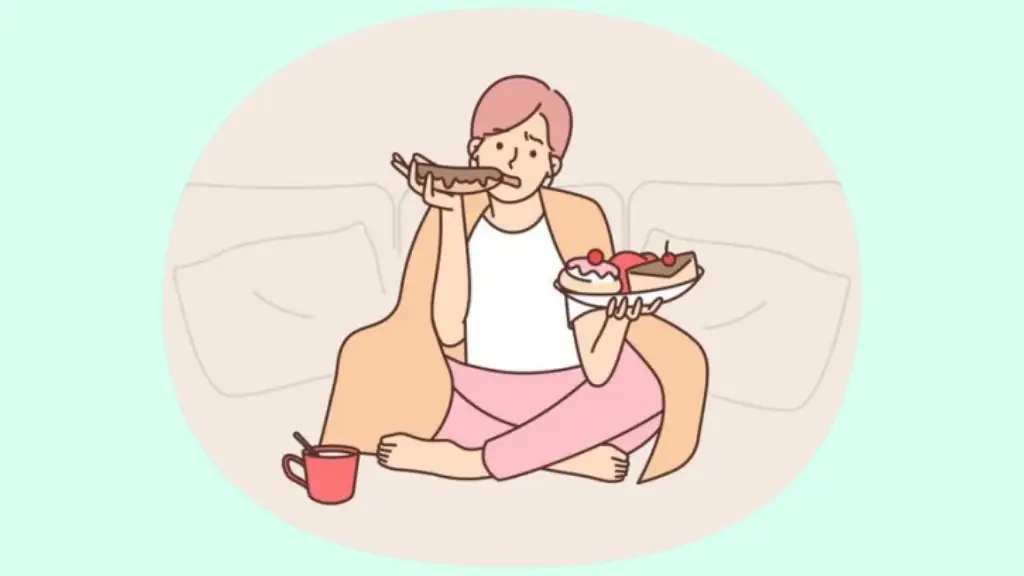
Have you ever found yourself eating dessert after a fight?
Or craving sugary foods when you feel disappointed?
Or reaching for a bag of chips after a stressful day?
If you have, then you are engaging in emotional eating or rather, eating our feelings away. In fact, there are multiple such things that we eat without even realizing how they are slowly dissipating our feelings away. This phenomenon of eating your feelings away is called emotional eating.
Emotional eating has been around for a long time. It is a way to comfort ourselves or drive away negative feelings rather than eating to satiate our hunger. Emotional eaters cope with states of anxiety, depressive moods, anger, and other negative emotions by snacking on their favourite foods (or sometimes consuming them in unusual amounts) rather than losing their appetite. According to the emotional eating theory:
- Negative emotions increase the motivation to eat (sometimes experienced as intense craving) and subsequently induce eating.
- Eating reduces the intensity of negative emotions.
Therefore, it works as an emotional regulation strategy that humans apply to feel better about themselves or their situations. And a habitual pattern of eating to cope with negative emotions can ultimately lead to obesity, binge-eating or bulimic tendencies.
Emotional Eating Disorder: When You Eat Your Feelings
Whenever something happens that upsets you, you feel an overwhelming urge to eat, your refrigerator becomes your go to place, you eat more than your stomach is asking for and then later feel guilty over your actions – you’re stuck in an emotional eating pattern. While emotional eating to regulate moods and emotions is commonplace and seems to fit the profile of a controlled emotion regulation strategy, it may turn uncontrolled and automatic in some cases. This is especially the case when emotional eating episodes have become habitual or compulsive. When eating becomes your go to coping mechanism in the times you’re stressed, upset, angry, lonely, exhausted or bored, you’re stuck in a never-ending cycle where your real feelings or situations are often ignored. Eating may feel good in the moment, but the feelings that triggered the eating are still there. And you often feel worse than you did before because of the unnecessary calories you’ve just consumed. You beat yourself for messing up and not having more willpower. Compounding the problem, you stop learning healthier ways to deal with your emotions, you have a harder and harder time controlling your weight, and you feel increasingly powerless over both food and your feelings. That’s when emotional eating reaches the disorder level, making it difficult to tackle on your own.
Therapy for Emotional Eating
Although occasional consumption of a chocolate bar might be considered an effective way to regulate our mood with no negative consequences to our well-being, emotional binge-eating and the associated obesity have severe consequences for our health and general well-being. For obese patients, dieting alone is not effective and a restriction on food intake may have a reverse effect i.e. cause further distress and induce a binge-eating episode. This makes education about recognizing emotional eating of utmost importance. Therefore, the first thing to do in therapy is to understand the causes of emotional eating and try to break the pattern. Since emotional eating is carried out in order to cope with negative emotions, improvement of emotion regulation skills is also crucial for the treatment. Additionally, improving the person’s emotion knowledge, self-monitoring of emotions and providing patients with alternative regulation strategies can help reduce pathological eating. Furthermore, because patients with eating disorders find it difficult or even impossible to enjoy eating, it will also be beneficial to promote the ability to enjoy eating (i.e., eating for pleasure) in addition to adaptive emotion regulation skills. Re-learning to enjoy eating can be an important part of therapy. Other therapeutic modalities that are effective in curbing emotional eating include:
- Cognitive Behavioural Therapy (CBT): This modality is considered one of the most effective therapies to treat emotional eating. It involves techniques that help recognize the stressors and resultant emotions and replaces the urge to eat with alternate positive actions. CBT is a common approach to support change in emotional eating by keeping a food and mood diary to identify the triggers and situational context of eating. A combination of CBT and mindfulness may be advantageous as they enable individuals to explore behaviour change techniques whilst also learning acceptance strategies to reduce emotional eating. Greater awareness of emotions and stress enabled individuals to improve regulation of eating and make healthier choices, which leads to fewer emotional eating episodes.
- Acceptance-based Interventions: These interventions include specific behavioural strategies (e.g., portion control and regular meals) to modify eating behaviour along with components of Acceptance and Commitment Therapy such as distress tolerance, mindfulness and commitment enhancement.
- Dialectical Behavior Therapy (DBT): DBT has been developed as a therapy to tackle emotional dysregulation. It focuses on distress tolerance, emotion regulations and mindfulness in combination to reduce eating your feelings away.
- Mindfulness-based Interventions: General stress reduction mindfulness techniques and mindful eating are quite effective in reversing emotional eating. Mindful eating techniques involve identifying and responding adaptively to food cravings, and engaging in skills for emotion regulation that would allow individuals to sit with, rather than trigger emotional eating. Furthermore, mindfulness skills emphasize on increased awareness, acceptance, and overriding of hedonic drives to eat, rather than promoting reliance on homeostatic cues to reduce consumption.
Emotional Eating Scale
The Emotional Eating Scale (EES) is designed to facilitate the investigation of relationships between specific negative emotional states and overeating. It is a 25-item scale and consists of three subscales: Anger/Frustration, Depression and Anxiety. It uses a Likert-type format to assess the intensity of the relationship of mood to eating. The five-point scale used was anchored between ”no desire to eat” to “an overwhelming urge to eat,” with “a small desire to eat,” “a moderate desire to eat,’’ and ”a strong desire to eat.”
How to Stop Emotional Eating
At some point or the other in our lives, we have all been guilty of eating our feelings away. That’s because eating is an inherently satisfying behavior. However, emotional eating isn’t exactly a healthy way to cope with difficulties or stress. So here’s Kilpatrick’s two-step method that can help you in overcoming emotional eating.
Step 1: Recognize your emotional eating behavior without judgement
The first step to effectively address your emotional eating is to recognize that you have been engaging in such behaviour. By recognizing that the only reason you’re eating right now is because of an uncomfortable emotion you’re feeling, you’re already one step closer to overcoming it. Once you’ve recognized it, the next step is to jot down one word or sentence that describes what you’re actually feeling. This may sound simple but in order truly be successful, you need to accept the behaviour without passing judgment on yourself. This is the difficult part. Because judgment isn’t serving you. Rather, it adds guilt and shame to the already big pile of emotions, making it even tougher to process what you’re actually feeling. As you take the step to recognize and acknowledge that you’re emotionally eating, remind yourself: I am a human going through something very stressful, and I’m dealing with it in a very human way.
Step 2: Finding an emotional solution to an emotional problem
In order to move beyond emotional eating, you need to feel the emotion and find a better way to cope with it or resolve the stressful situation. Accepting and addressing uncomfortable emotions is hard. If you’re feeling overwhelmed and need to save Step 2 for later, that’s okay! But, ultimately, the goal is to identify a more productive way to handle what you’re feeling. Here are a few recommendations for the right solution to your problems. But remember, every person is different and some solutions may work for you and other solutions may work for others. What becomes your go-to solution will ultimately depend on you as a person and what emotion you’re struggling with.
- Stress: Breathing exercises or yoga, meditation, going for a walk in a quiet place
- Loneliness: Text, call or video chat with a loved one, going out with friends or family, enrolling yourself in some classes that interest you and where you can meet new people
- Sadness: Making a list of things that you’re grateful for, engaging in a hobby, watching some comedy show or movie to laugh along
- Boredom: Finishing a pending project, reading a book, watching a movie
- Anxiety: Talking or confiding in a friend, spending time with pets (if you have any) or your child, considering taking therapy
Replacing food with one of the more productive solutions above is really the only way to overcome emotional eating long-term.
Emotional eating is often less about food and more about trying to soothe difficult emotions, stress, loneliness, or overwhelm. While eating our feelings may bring temporary comfort, it rarely resolves the underlying emotional struggle. Learning healthier coping strategies, building emotional awareness, and seeking professional support when needed can help break the cycle of emotional eating and create a more balanced relationship with both food and emotions.
Photo Credits:
First image: Denis Novikov
References
Arnow, B., Kenardy, J., & Agras, W. S. (1995). The Emotional Eating Scale: The development of a measure to assess coping with negative affect by eating. International journal of eating disorders, 18(1), 79-90.
Macht, M., & Simons, G. (2010). Emotional eating. In Emotion regulation and well-being (pp. 281-295). New York, NY: Springer New York.
McCallum, K. (2020). A Dietitian’s No-Nonsense Guide to Fighting Emotional Eating. Houston Methodist. https://www.houstonmethodist.org/blog/articles/2020/dec/a-dietitians-no-nonsense-guide-to-fighting-emotional-eating/
Rozakou-Soumalia, N., Dârvariu, Ş., & Sjögren, J. M. (2021). Dialectical Behaviour Therapy Improves Emotion Dysregulation Mainly in Binge Eating Disorder and Bulimia Nervosa: A Systematic Review and Meta-Analysis. Journal of personalized medicine, 11(9), 931.
Smith, J., Ang, X. Q., Giles, E. L., & Traviss-Turner, G. (2023). Emotional eating interventions for adults living with overweight or obesity: a systematic review and meta-analysis. International journal of environmental research and public health, 20(3), 2722.
Smith, M., Robinson, L., Segal, J. (2026). Emotional eating and how to stop it. HelpGuide.org. https://www.helpguide.org/wellness/weight-loss/emotional-eating

Sakshi
About the author
Sakshi is a clinical psychologist with a deep passion for understanding human behavior, a strong drive for research, and a keen eye for psychological intricacies. Committed to continuous learning, she seeks to explore every facet of psychology, from theory to practice, to better support and empower individuals. With a curiosity that fuels her pursuit of knowledge, she strives to bridge the gap between research and real-world applications, making psychology more accessible and impactful.
Recently Added
At least once in our lifetimes, we have been involved in or enmeshed in unhealthy and manipulative relationships where we have, knowingly …

The ideal conditions for creativity are often mental and emotional – involving relaxed, yet alert and focused, states of mind. By contrast, …

Spirituality empowers human existence with meaning. It helps establish goals and value systems that drive almost all aspects of a person’s life. …